NAME
gnome-aio
PROBLEM STATEMENT
Writing a RuneScape bot has always meant writing code. Each new behaviour is another Java file, another deploy, another build cycle. The skill ceiling for getting a bot to do anything useful is the skill ceiling of Java engineering, and the time-to-iterate on a new strategy is measured in hours.
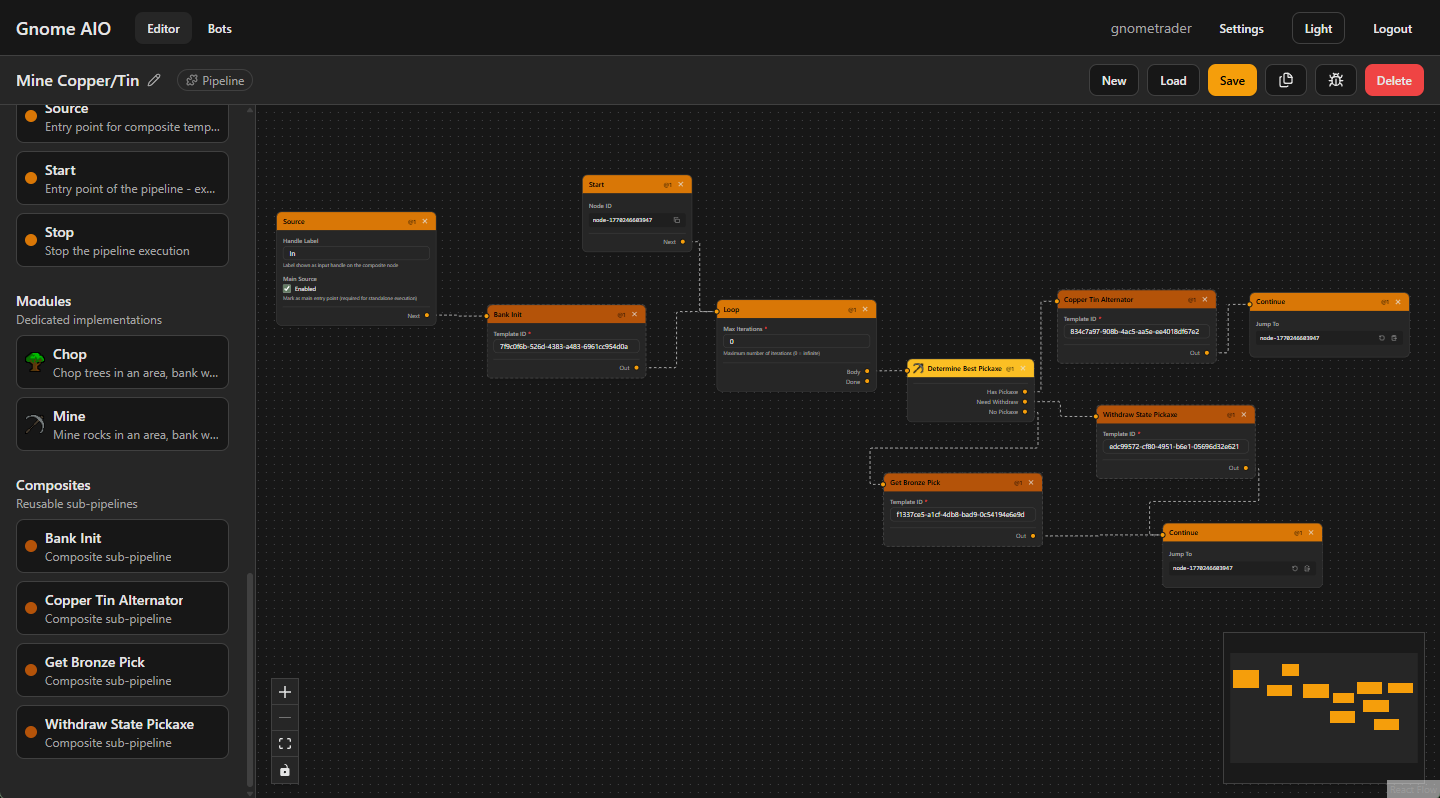
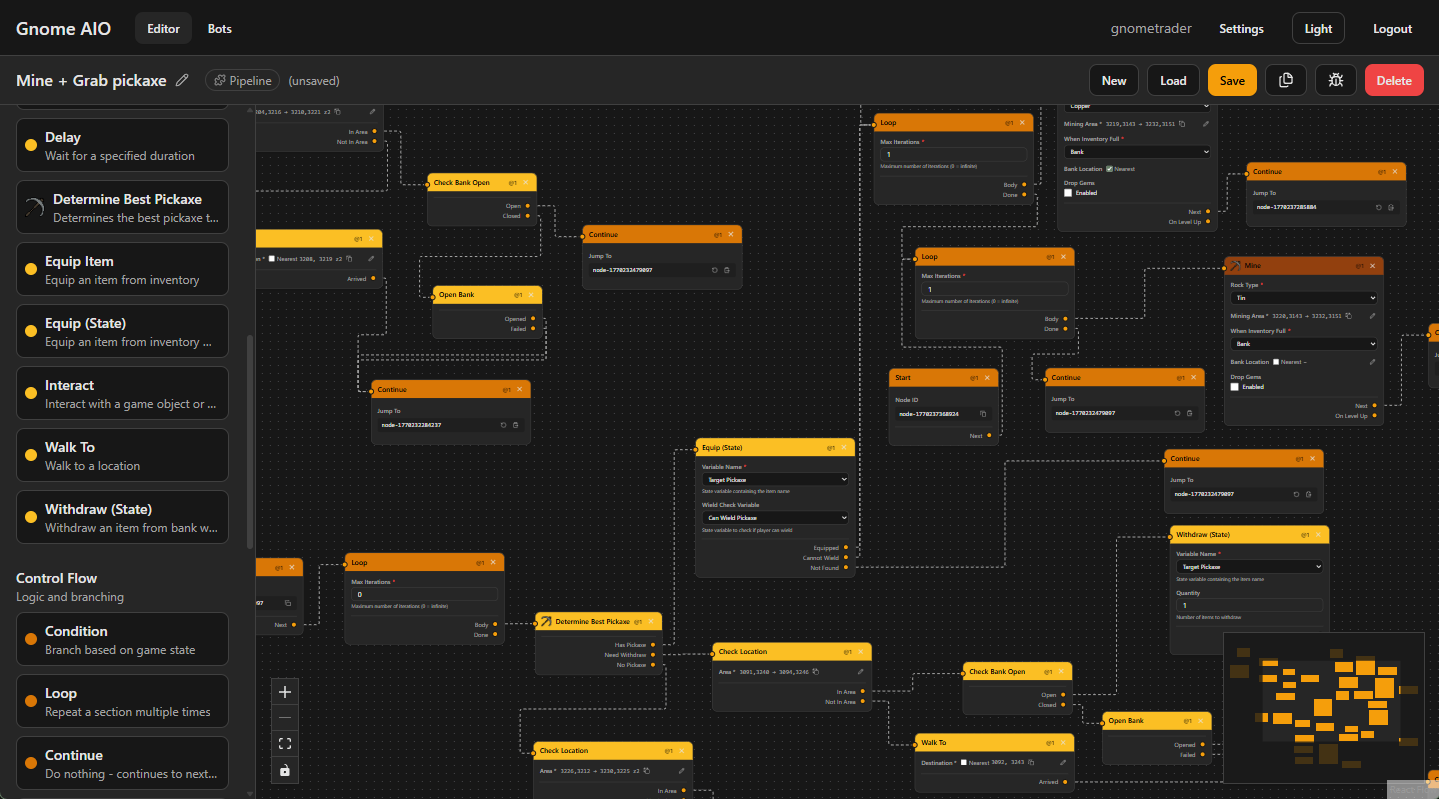
GnomeAIO turns bot logic into a graph that a non-programmer can compose visually. Players drag nodes onto a canvas, wire them together to describe control flow and data flow, and a Java bot walks the graph at runtime. The same bot binary executes any pipeline. No recompile, no deploy.
The same scaffold supports nested templates (composites), data channels that pipe values across the graph, and a live trace that pulses the currently-executing node in the user's browser as the bot moves through the in-game world.
The longer-term intent was to plug GnomeAIO bots into Gnome Trader. A bot swarm that needs gold to function (think a bot training combat that needs to keep buying food) could place orders against the Gnome Trader marketplace automatically, closing another loop between the two systems.
ARCHITECTURE
Two services and a relay, plus a Java bot and a React client.
   ┌──────────────┐                         ┌──────────────┐
   │   Browser    │                         │   Web API    │
   │ (React Flow) │───────── http ─────────▶│  (FastAPI)   │
   └──────────────┘                         └──────────────┘

   ┌──────────────┐                         ┌──────────────┐
   │   Java Bot   │                         │   Web API    │
   │  (RuneMate)  │─── http (pipeline) ────▶│              │
   └──────────────┘                         └──────────────┘

   ┌──────────────┐                         ┌──────────────┐
   │   Java Bot   │                         │ Trace Relay  │
   │ GraphWalker  │───── http (trace) ─────▶│ (Cloud Run)  │
   └──────────────┘                         └──────────────┘

   ┌──────────────┐                         ┌──────────────┐
   │   Browser    │                         │ Trace Relay  │
   │ (React Flow) │◀──── sse push ──────────│ (Cloud Run)  │
   └──────────────┘                         └──────────────┘

   ┌─ shared substrate ──────────────────────────────────────┐
   │  Postgres   · pipelines · nodes · users · marketplace   │
   │  Redis      · sessions · caching                        │
   └─────────────────────────────────────────────────────────┘
Web API is a FastAPI service on App Engine Standard. It owns pipelines, the node catalogue, marketplace listings, and authentication (Phantom wallet signatures with Redis-backed sessions, same model as Gnome Trader).
Java bot runs
under RuneMate. On launch it fetches the active
pipeline as a stripped graph_bot
payload, then runs the GraphWalker against live
game state every tick.
Trace Relay is a small FastAPI service on Cloud Run that holds open SSE connections. The bot posts the current node id over HTTP, the relay fans it out to any browser subscribed to that bot's stream. Decoupling the relay from the main API keeps a noisy bot from affecting the editor's responsiveness.
Client is React 19 with React Flow and Radix UI. The same canvas serves both the editor and the live trace overlay, so the player sees their own graph pulse as the bot moves through it.
Substrate: Postgres for durable state (pipelines, nodes, users, marketplace), Redis for sessions and caching.
LIFECYCLE
How a pipeline runs:
- Player composes a graph in the React Flow editor.
- On save, the API stores two forms:
graph_fullfor the UI, andgraph_botstripped of UI-only metadata for the bot. - Bot launches in RuneMate, authenticates, and fetches
graph_botfor the current pipeline. - The GraphWalker is called on every game tick.
- Each call "drops a marble from the top": the walker traverses from the entry node through control-flow nodes (conditions, loops, data evaluators) until landing on an action node.
- The action node executes against the current game state.
- While an action is RUNNING (for example, walking to a target tile), subsequent ticks tick the same action.
- When the action returns EXECUTED, the walker either follows the action's output handle or re-traverses from the entry node on the next tick.
- Throughout, the walker posts the current node id to the trace relay, which fans it out via SSE to any browser watching this bot. The frontend pulses the matching node green.
The marble-drop model is deliberate. Game state can change between ticks (a tile becomes blocked, an interface closes itself, a player walks into view), so any decision the walker made one tick may be invalid the next. Re-evaluating from the entry every time is the simplest model that always reflects the current state.
/**
 * Decision tree walker for pipeline execution.
 *
 * Each step() call "drops a marble from the top" - traversing from
 * the entry node through control flow nodes until reaching an action
 * node, then executing that action.
 *
 * Key behaviors:
 * - Control flow nodes (condition) are evaluated against current game state
 * - Action nodes (module, primitive) are where execution "lands"
 * - RUNNING actions are ticked on subsequent calls until complete
 * - Fresh traversal from entry on each iteration (unless action is RUNNING)
 */
public class GraphWalker {

    public boolean step() {
        // Check execution limits
        if (!checkLimits()) {
            return false;
        }

        // Get current game state with state provider for variable access
        Map<String, Object> gameState = stateProvider.getState();
        gameState.put("__stateProvider", stateProvider);

        // If we have an active running action, tick it
        if (activeActionNodeId != null && activeActionExecutor != null) {
            return tickActiveAction(gameState);
        }

        // If we have a pending jump from invisible edge, resume from target
        if (pendingJumpNodeId != null) {
            String jumpTarget = pendingJumpNodeId;
            pendingJumpNodeId = null;
            PipelineNode targetNode = graph.getNode(jumpTarget);
            if (targetNode != null) {
                return traverseFromNode(targetNode, gameState);
            }
        }

        // Fresh traversal from entry - clear step-scoped data from previous step
        stepDataOutputs.clear();
        return traverseAndExecute(gameState);
    }
} ENGINEERING DECISIONS
Graph as state, bot as walker. The bot has no behaviour of its own. It is a graph interpreter. New behaviour is a new graph, not a new binary, not a new deploy.
Two-layer graph (control + data). Control edges drive execution flow. Data edges carry typed values. Named "data channels" let a value produced in one corner of the graph be read in another without explicit wiring across half a canvas.
Composites flatten at save time. Sub-graphs the player composes once and reuses are expanded into their final form on save, with composite node ids prefixed to disambiguate. The walker never sees composites at runtime, just the flattened graph. Avoids a recursive walker.
Three data scopes. Constant data outputs are pre-populated at init and immutable. Step-scoped data is cleared at the start of every step. Data channels persist across steps until overwritten. Three scopes covered every real case without needing a general variable store.
JSON Logic for conditions.
Instead of inventing an expression language,
conditions are JSON Logic. A condition like
{"<": [{"var": "stats.mining"}, 15]}
reads as "mining level under 15". Composable,
parseable in both Python and Java, no parser to
maintain.
category:name@version node identity.
Every node carries its category, name, and version.
When a node's implementation changes, old pipelines
can keep running against the old version, or be
migrated explicitly.
Safety limits everywhere. Max traversal depth, max actions per step, action timeout, max total executions, max runtime. A graph editor encourages loops, and the bot will run them. The walker refuses to.
Trace as a separate Cloud Run service. The trace relay is a tiny stateless service. Bots post node updates, browsers subscribe via SSE. The editor and the trace can scale independently, and a busy bot fleet does not slow down the canvas.
STACK
- backend
- FastAPI, Python, SQLModel, PostgreSQL, Redis
- frontend
- React 19, TypeScript, Vite, React Flow (@xyflow/react), Radix UI, Tailwind
- bot
- Java, RuneMate botting framework, Lombok, Log4j2
- conditions
- JSON Logic
- auth
- Phantom wallet signatures + Redis sessions
- trace
- FastAPI on Cloud Run, SSE via sse-starlette
- infra
- Google App Engine Standard (Web API), Cloud Run (Trace Relay)
POSTMORTEM
Summary. GnomeAIO was discontinued because the visual programming model failed at its goal. The intent was to let non-programmers compose bot behaviour by wiring nodes. The reality was that composing a useful pipeline required programmer-level thinking, which made the canvas a worse environment for the people who could use it and an impossible one for the people who could not. Multi-bot orchestration was the part of the system that genuinely worked, but it was not enough to justify the rest, and it did not carry over into the next project either.
The abstraction trap. The granularity that gave the system its power was the same thing that made it unusable. To compose a useful pipeline you had to think in control flow, data flow, conditions, and state. If you can think that way you would just write the bot in Java directly and be done. If you cannot, you would never finish a pipeline. The visual layer did not replace the programming skill, it relocated it onto a canvas.
What worked. Multi-bot orchestration was remarkably good. The platform handled a swarm of bots through the same graph editor with far less ceremony than the standard approaches in this space (which tend to be scattered scripts and many different bits of software on different servers). Even if the per-bot graph was overkill for one bot, the way the platform managed many bots was a real improvement over what is normal here.
The trace UI. The most novel piece, and the most enjoyable to build. Watching nodes pulse as a live bot worked through the graph was genuinely striking. It was also, in the end, ornamental. A pretty visualisation does not justify a tool nobody can use.
What I would do differently. The platform did support fat nodes that bundled lots of activity, and you could even publish them to a node store for other users to download. Two problems emerged. The first was practical: maintaining a sprawl of bundled behaviours across the marketplace was a nightmare. The second was conceptual, and more damaging: once each useful behaviour fits in a single node, the graph editor is not adding anything. If "do the quest" is one node, what is the canvas actually buying you?
Future. The conclusion led directly to the next project, which went in the opposite direction. A single all-in-one bot, fully self-managed, no external integrations, no graph editor, no marketplace, no orchestration layer. The user passes a stat sheet of target skill levels and the bot computes the best path itself, with break timers built in instead of composed. The graph walker survives only as an internal implementation detail of the new bot, not as a user-facing tool. Multiple programmers contribute to the same bot repo, and revenue is shared based on which contributions are actually used. GnomeAIO's premise was that the user wanted freedom. The next project removes the freedom on purpose.
SCREENSHOTS
Two pipelines from the editor, showing the kind of behaviour users wired by hand.